Agentic Engineering Framework
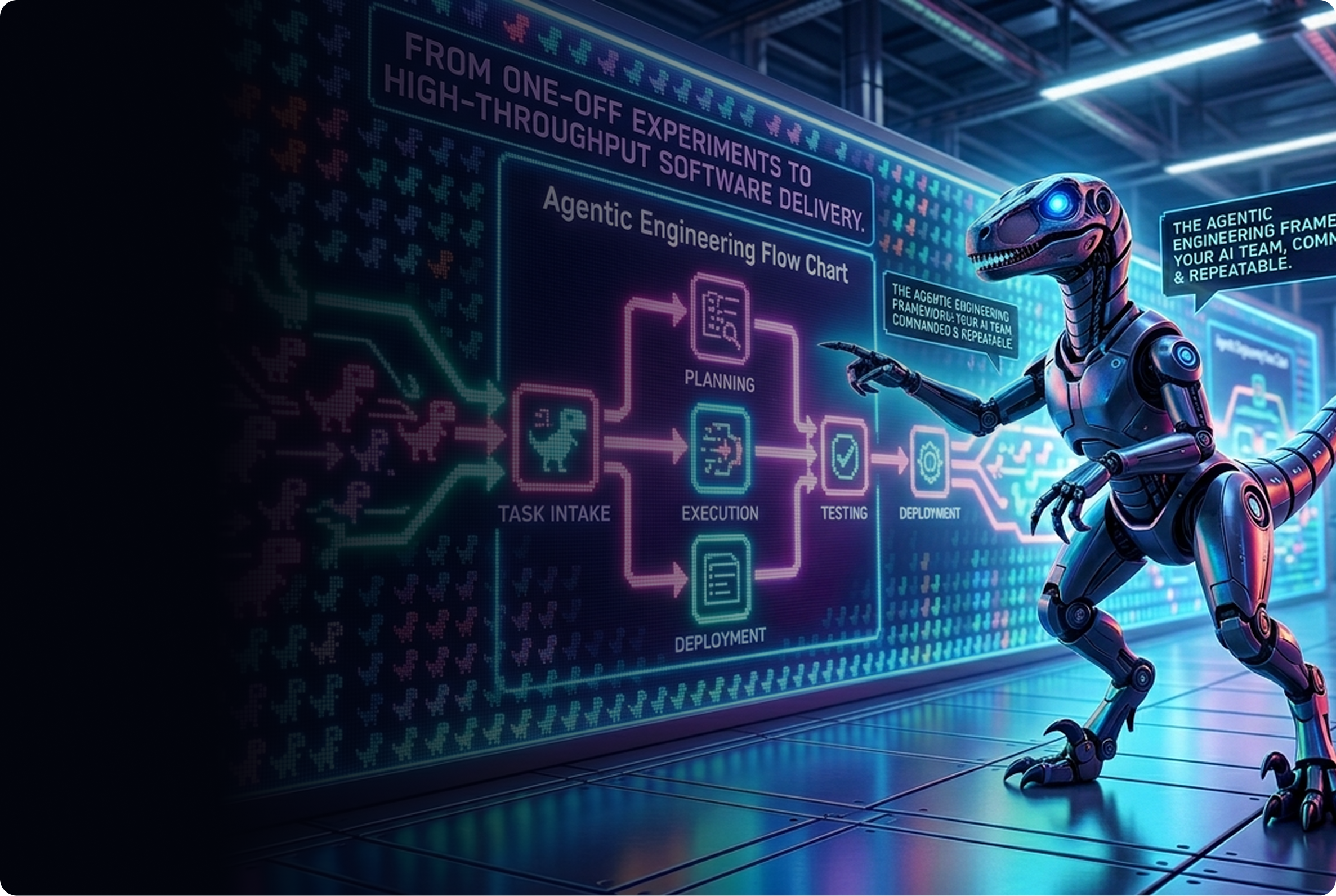
Ship with AI agents.
Keep engineering in command.
The multi-agent harness for AI coding — structured workflows, specialist agents, adversarial review, browser QA, and project memory that survives between sessions.
Tell your agent to:


Powered by
Your expert in AI-augmented software delivery. Talk to Us Today!
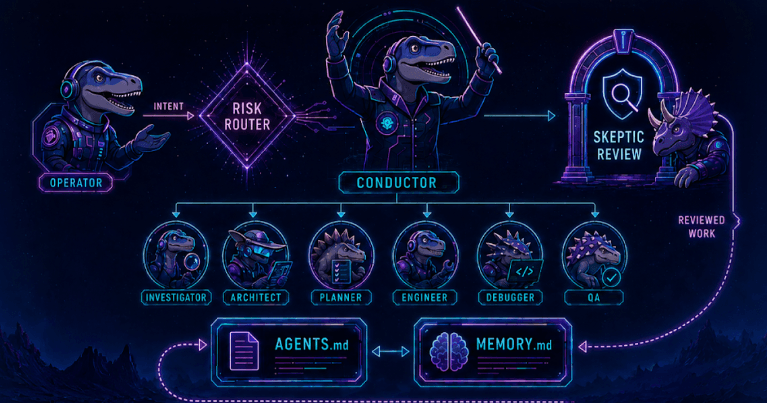
The DinoStack Attention Architecture
Humans supply intent and judgment. The conductor classifies risk, keeps context light, fans work out to specialists, and only lets reviewed output move forward. Memory flows back into the next session, so the system compounds instead of restarting cold.
The Problem & Our Origin
Coding agents can move fast.
They can also drift, overfill context, skip review, forget project conventions, and start implementing before the work is properly framed.
Small tasks stay lightweight. Risky work gets structure. Complex work gets orchestration. DinoStack turns agentic coding into an engineering system.

The framework we built for ourselves
Space Dinosaurs builds AI-augmented systems for teams that care about outcomes, velocity, and quality. DinoStack is our open framework — field-tested patterns for reliable, inspectable, repeatable AI development, brought into the open so any team can use them.
About Space Dinosaurs →What DinoStack does
Plans before it edits
Frames the work before touching code — goal, constraints, files, risks, and verification path. Fewer half-built branches. Fewer invented requirements.
Routes work to the right agent
Treats the main agent like a conductor. Specialist agents handle focused jobs — architecture, debugging, review, browser QA, security — each with a narrow brief and clean context.
Reviews with teeth
Adversarial review that starts fresh — the reviewer sees only the output and brief, not the implementer's reasoning trail. Critical findings block. Major findings require an explicit decision.
Verifies behavior, not vibes
For UI changes, a QA agent opens the app, navigates, clicks, screenshots, and reports what actually happened. "Looks right in code" is not the same as "works for a user."
Keeps context clean
Heavy work happens in focused subagents. The main session gets structured summaries — less context rot, less amnesia, fewer repeated explanations.
Preserves project knowledge
Conventions, decisions, QA rules, and failure modes carried forward between sessions. Your agent stops rediscovering the same facts every time.
Plans before it edits
Frames the work before touching code — goal, constraints, files, risks, and verification path. Fewer half-built branches. Fewer invented requirements.
Routes work to the right agent
Treats the main agent like a conductor. Specialist agents handle focused jobs — architecture, debugging, review, browser QA, security — each with a narrow brief and clean context.
Reviews with teeth
Adversarial review that starts fresh — the reviewer sees only the output and brief, not the implementer's reasoning trail. Critical findings block. Major findings require an explicit decision.
Verifies behavior, not vibes
For UI changes, a QA agent opens the app, navigates, clicks, screenshots, and reports what actually happened. "Looks right in code" is not the same as "works for a user."
Keeps context clean
Heavy work happens in focused subagents. The main session gets structured summaries — less context rot, less amnesia, fewer repeated explanations.
Preserves project knowledge
Conventions, decisions, QA rules, and failure modes carried forward between sessions. Your agent stops rediscovering the same facts every time.
DinoStack intelligently escalates by risk
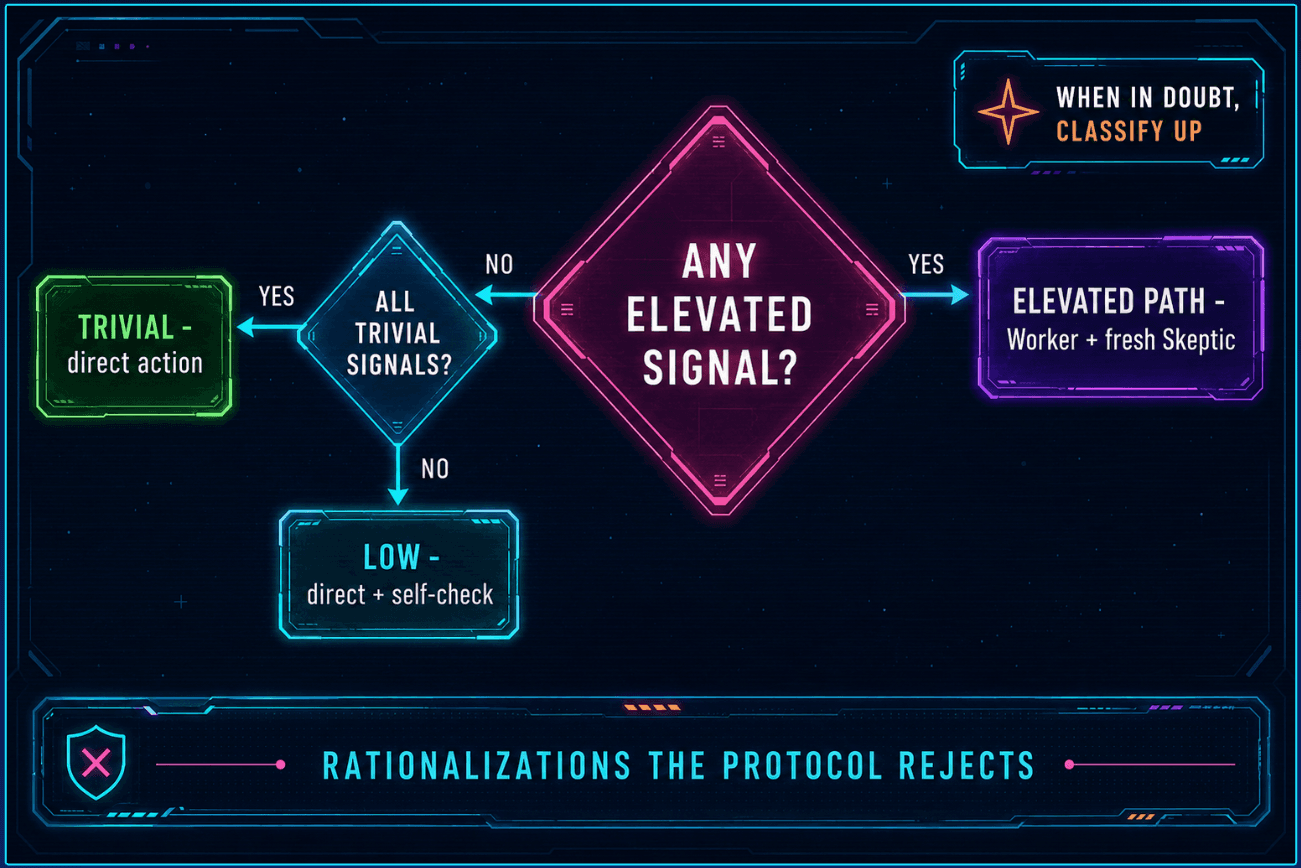
Not every change deserves the same ceremony. DinoStack routes trivial work to direct action, low-risk work to direct execution with a self-check, and anything with an elevated signal to a Worker plus a fresh Skeptic review. When in doubt, the protocol classifies up. Rationalizations to skip the harder path are rejected by design.
How the workflow feels
DinoStack does not turn every task into a ceremony. It applies structure where structure pays for itself.
DinoStack continuously reviews and QAs
Implementation, adversarial review, and runtime QA run as a bounded loop with a hard pass cap. Phase state is written atomically so rate limits or session exits never erase completed work. Every Critical or Major finding ships with a regression test.
Engineer implements
The Worker agent executes the scoped brief in a clean, focused context. Implementation follows the plan and the project's defined conventions.
Skeptic reviews
A fresh Skeptic agent reviews independently — it sees the output and the brief, not the implementer's reasoning trail. Critical findings block. Major findings require action or an explicit decision.
QA verifies in browser
The QA gate verifies in browser or runtime. The agent opens the app, navigates, clicks, screenshots, checks browser errors, and reports what actually happened.
Designed for real development teams
Tell your agent to:
- Risk-aware execution
- DinoStack uses profiles to tune how aggressively work is reviewed. Move faster for low-risk changes. Add stricter gates when correctness matters.
- Parallel fan-out
- Independent work can run in parallel through separate agents. Interdependent work stays sequenced. You get concurrency without turning the project into a pile of conflicting branches.
- Bounded loops
- Implementation, review, and QA loops stay constrained. Failures are tracked. Findings carry forward. The system gets harder to fool as work progresses.
- Project-level instructions
- Every team works differently. DinoStack lets projects define tracking rules, review expectations, QA setup, conventions, and local operating norms.
- Tool-adapted, methodology-first
- DinoStack is designed to work where developers already work. The framework can be adapted to agentic coding environments rather than forcing a separate platform.
Tell your agent to:
Open source core. Commercial depth where teams need it.
DinoStack's core framework is open-source because agentic engineering should be inspectable, extensible, and improved in public.
Space Dinosaurs will continue building commercial offerings around the framework for teams that want deeper support:
Training and enablement
Hands-on onboarding for engineering teams adopting agentic development workflows. We help teams install the framework, tune review profiles, define project instructions, and build durable operating habits.
Implementation support
Guided rollout for teams that want DinoStack integrated into real repos, real workflows, and real delivery systems.
Ecommerce Skill Pack
A closed-source commercial add-on for ecommerce teams. The Ecommerce Skill Pack extends DinoStack with domain-specific agents, workflows, review patterns, and implementation guidance for commerce builds, migrations, conversion work, storefront QA, and revenue-critical changes.
Ask about the Ecommerce Skill PackWho DinoStack is for

DinoStack is for developers and teams who are already using AI coding agents and want more disciplined results.
Use it when:
- Agent sessions get messy after the first hour.
- Complex requests turn into sprawling, unfocused implementation.
- Reviews feel too soft or too dependent on the original agent's assumptions.
- Your AI assistant keeps forgetting project conventions.
- You want parallel agent work without losing control.
- You need a repeatable operating model your whole team can share.
- You care about shipping faster without quietly lowering your engineering bar.
Built for the next phase of software development
The next advantage in AI-assisted engineering will not come from asking agents to write more code.
It will come from better operating discipline.
DinoStack gives your agents a protocol for planning, delegation, review, verification, memory, and recovery. It turns raw model capability into a system developers can trust, inspect, and improve.
Tell your agent to:
Powered by Space Dinosaurs, your expert in AI-augmented software delivery.